By: Frieda Arenos
Interested in sharing your perspective on how we can better solve problems together? Review our submission guidelines and send us your piece!
The Senator I used to work for always said, “If we all agreed, it wouldn’t be a democracy.” And yet, often, our first instinct is to become angry when someone disagrees, instead of asking “why?” and “help me understand your perspective.” How did we lose sight of the fact that we’re all unique people with different convictions, cultures, and experiences that shape how we see the world? When did we forget how to be with one another?
Just over a year ago, I found myself at a sudden crossroads in my career; an unexpected moment thrust upon me through efforts to reduce the federal workforce. Having landed my dream job as a civil servant at USAID after the birth of my first child, I spent the following year and a half working tirelessly. I soaked in every moment and worked myself to the brink, not only because I felt like part of a larger mission that was driving good around the world, but because I loved every second of it. When DOGE eliminated my Agency, I was angry. I felt unsupported by those who stood by idly and disheartened by the false narratives about my Agency and its work.
But everything I gained from my time there and before had taught me to face these frustrations head-on. Before becoming a civil servant, I worked in democracy development, traveling the world and working with governments to incorporate principles that would enable citizen engagement, representative lawmaking, and two-way communication. As a civil servant, you’re trained to be impartial, bipartisan, and nonpartisan. You serve as a bridge, an objective force that exists to uphold the process and institution to ensure the ultimate efficacy of the political mission at large. My work was only successful if I was engaging across parties, bringing opposing sides together, even if only to sit in the same room with one another for mere moments. Before that, I worked for nearly a decade as a staffer in the US Senate. I learned that collaborating with colleagues across the aisle was not only good for policy but also made for a better work experience and outcomes, especially when it came to funding decisions.
Sometimes, our pre-conceived notions of how the other will treat us, what they will say, and how they will react send our brains spiraling with anxiety even before we’ve entered a room. This is normal, actually — our brains do this to protect us from being overwhelmed by the massive amount of information we must filter to make decisions every day. It is called “confirmation bias,” and it results in our brains unintentionally interpreting, favoring, or recalling information that confirms our pre-existing beliefs. It’s how we’ve survived as humans, having to make millions of decisions all these years. Unfortunately, this protection mechanism can also block us from engaging through humility and an appreciation of difference.
I’ll give you an example of this from my own experience, where both sides presumed the other’s intentions. In 2024, I inadvertently found myself at the helm of an interagency effort to unblock a congressional hold on funding. The government would not move the funding forward without congressional approval. Agency leaders assumed that Congress didn’t want it to go through because of their political agenda – the problem was, they never had an actual conversation with the members of Congress and staff involved. As part of my role, I was in a position to work with Congress and decision-makers across the agencies to be a sounding board and help each side understand the other’s intentions. I uncovered that Congress was frustrated by the lack of information-sharing from the agencies, which they assumed meant the agencies didn’t care about their concerns. As the deadline approached, I was not going to let critical funding remain stuck if I could help it. It took many weeks and hundreds of emails and calls, but through my efforts to facilitate clarity and communication to each side, we gained congressional approval for the funding to move forward.
Today, I am thankful to have landed at The ONE Campaign. The staff here consists of a mix of Democrats and Republicans, and those who currently feel “politically homeless” — people of all judgments. We don’t always agree — in fact, we disagree a lot because today’s politics are charged. But we have a common anchor grounded in our mission, and we respect one another. I also work with political staff in the current Administration, including those who signed off on my termination, willingly. I am close with Senate and House offices from both parties, even those who voted to eliminate my Agency. I have made friends in unlikely places and those with whom we do not share the same political views. But these friendships have led us all to better policy outcomes because we’re challenging ourselves to push past preconceived notions and recognize we all have a stake in seeing our world do better.
I’m certainly not asking us to agree or get along with one another. I’m just asking us to stop and listen before we judge and act. Let’s get back to cordiality, humility, and a recognition of human nature. Our experience shapes our bias, even when we don’t mean it, but when we approach division with an open mind, we find ultimate solutions.
Spaces to connect and collaborate across divides matter now more than ever.
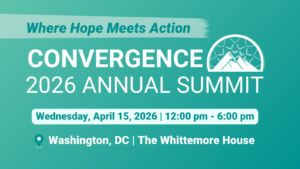
On April 15th, join me alongside thought leaders and friends in Washington, DC, for the Convergence 2026 Annual Summit: Where Hope Meets Action. Learn more and register here.